
France’s foreign minister said Monday that Russia’s ambassador in Paris would be summoned over “a vast cyber campaign” across Europe.
“We will also impose sanctions on nine individuals and four entities responsible for this cyber campaign, which was orchestrated by the FSB,” Russia’s primary national intelligence and security service, Foreign Minister Jean-Noel Barrot, said in an interview with BFMTV/RMC.
He made the announcement as the European Union and United Kingdom announced similar sanctions.
The Russian attacks, which allegedly targeted companies, government ministries and service operators, were attempts at “sabotage and espionage in a dozen European countries,” Barrot said.
The goal was either “capturing information or sabotaging operations, for example rail infrastructure, as was the case in Poland,” he said. Poland’s top diplomat accused Russia of an “act of state terror” in November last year after two Ukrainian nationals allegedly working closely with Russian secret services were accused of blowing up a railway line in the country.
Wojtek RADWANSKI/AFP/Getty 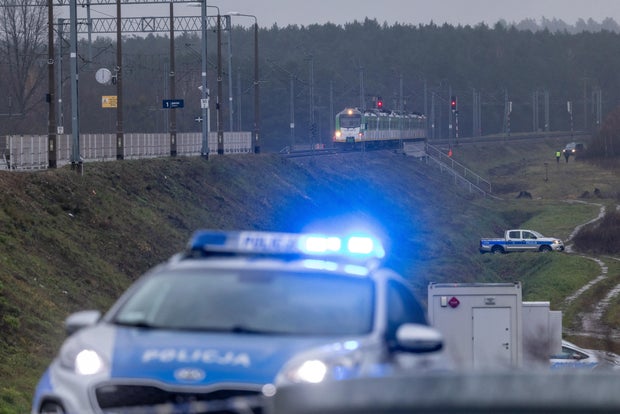
Barrot said Monday that France was able to “detect these attacks,” having “significantly strengthened our defenses against these cyber attacks.”
The EU denounced “Russia’s malicious cyber ecosystem” on Monday, meanwhile, for targeting the bloc and its member countries.
In a statement, the EU condemned Russia for the “leveraging of a cyber ecosystem encompassing state and non-state actors, ranging from intelligence services to cybercriminals groups, hacktivists and private companies.”
The EU accused the FSB of controlling a “variety of cyber threat groups” and said its activities included “infiltration of governmental networks and sabotage of critical infrastructure.”
France, Germany, Poland, Cyprus, the Netherlands, Austria, Slovakia, Romania and Finland have been targeted, among other nations, causing “disruptions and financial losses,” the bloc said.
The EU said it was sanctioning nine individuals and four entities, including officers with the Russian military intelligence agency GRU, “as well as cybercriminals, self-proclaimed hacktivists and private companies.”
The U.K. government said it was sanctioning 24 individuals and entities for “cyber and hybrid operations.”
The new measures and accusations came as France prepared to host a summit of the “Coalition of the Willing” – a group of Ukraine’s allies – in Paris on Monday.
Kremlin spokesman Dmitry Peskov called the group “a coalition of warmongers,” adding: “These are the countries that are undertaking hostile actions against Russia, so we will be watching very closely.”
In April, Sweden revealed it had foiled a Russian cyberattack targeting a thermal power plant the previous year. The announcement came after Poland, Norway, Denmark and Latvia warned that Russia was targeting critical infrastructure across Europe.
In addition to the November 2025 attack on the Polish railway line, an alleged FSB plot to attack Poland’s energy grid a month later “could have caused 500,000 civilians to lose electricity” had it succeeded, according to the U.K. government.
A spate of mysterious drone sightings near airports and military bases across Western Europe has also widely been attributed to Russia, in addition to more blatant incursions into NATO airspace by Russian warplanes.
Some of America’s allies have said for months that Europe is in a gray zone between peace and war with Russia — accusing Moscow of escalating “hybrid warfare.”