
Palestinian-American Loui Ridi said he could only watch via security cameras from his home in Ohio as Israeli settlers laid siege to his house in the village of Qusra, in the Israeli-occupied West Bank, for over a week.
Settlers have long illegally seized Palestinian homes in the West Bank, but the attacks have stepped up in recent years amid vows by Prime Minister Benjamin Netanyahu to establish new settler outposts and legalize more existing ones.
After a week watching the siege play out from Toledo, and with settlers encircling two other houses in the area, Ridi, 46, told the Reuters news agency that he boarded a flight to Tel Aviv in an attempt to return to the village where he grew up, and to reclaim his home.
U.S. Ambassador to Israel Mike Huckabee referred to the settlers behind the unrest as “terrorists” last week in a stinging rebuke.
JAAFAR ASHTIYEH /AFP via Getty Images 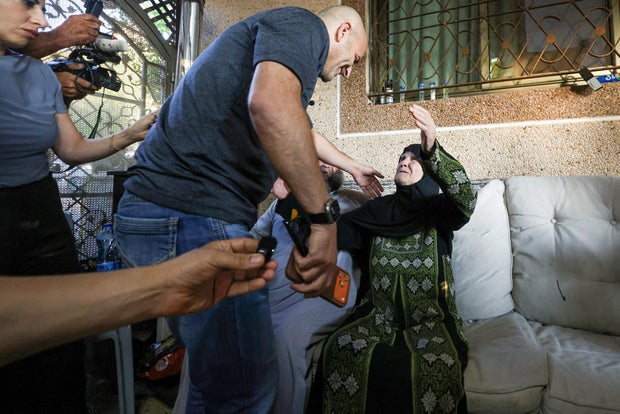
Israeli troops have been deployed to the area ostensibly to keep the peace, but after more than a week, settlers remained in the area and the Palestinians are still too afraid to leave their homes, according to Reuters. Activists say Israeli authorities rarely intervene to stop settler violence. The Israeli human rights organization B’Tselem has documented joint attacks on Palestinians by settlers, police and soldiers.
“I can’t let the settlers steal my house while I was watching,” he told Reuters after arriving at Tel Aviv’s Ben Gurion airport.
Reuters followed his journey back to Qusra, a small village frequently subjected to settler attacks. As he traveled up a hill to his home, multiple settlers and Israeli troops could be seen nearby.
Ridi hung back for a while, before he and several journalists got an escort from an Israeli military vehicle to his family home. When he finally entered the house as the sun set, he climbed to the roof and raised an American flag.
“The settlers shouldn’t be here,” he said.
Worsening settler violence
All Israeli settlements in the West Bank are considered illegal under international law, but they’ve been encouraged by Israel’s current government, which swung sharply to the right when Netanyahu formed his governing coalition with parties that had long existed on the far-right fringe of Israeli politics.
Israel disputes the international position that all West Bank settlements are illegal, arguing that most are legal under its own domestic law, and that the area is disputed territory.
CBS News documented first-hand accounts of rising settler violence against Palestinians in the West Bank in 2023 — a trend that activists and the United Nations say has only increased since the Oct. 7, 2023, Hamas-led attack sparked the war in Gaza. Critics say Netanyahu’s government, which includes ultranationalist, pro-settler ministers, has emboldened the settlers, leading to the increase in attacks.
Excluding East Jerusalem, more than 500,000 Israelis live in settlements across the West Bank, which has been occupied by Israel since 1967, alongside around three million Palestinians.
Trapped under siege
Ridi said he started building his Qusra home on land owned by his family in 2023. He wanted his daughters to have a home where he grew up, to stay connected to their heritage.
Ridi’s brother Qusay has remained in the home along with a nephew, in increasingly dire conditions, to protect it from the settlers. According to the U.N., they’re among 15 Palestinians, including two children, who have been trapped by settlers inside Qusra homes without running water or electricity.
Between January 2017 and September 2025, more than 1,500 Palestinians were killed in the occupied West Bank by both settlers and Israeli security forces, according to the U.N.
Asked what he planned to do next, Ridi told Reuters he wanted “to sit with my brother, catch up and see how they’re doing.”