
A researcher in the Netherlands found an incredibly rare fragment of Homer’s epic “Odyssey” that is over 1,700 years old sandwiched between the pages of a library book.
The find was made by Dr. Mark de Kreij, of Radboud University in the Netherlands, while he participated in a project to study and publish ancient manuscripts held by Utrecht University. He made the find about two years ago, local media reported, but the university only announced the discovery this week.
De Kreij identified the tiny slip of paper while looking at a collection of early Christian manuscripts purchased by the university in the mid-20th century, according to a news release from the institution. At first, researchers thought it was a piece of paper from the 7th century. Several similar fragments, in Egyptian, had already been found in the collection.
Utrecht University 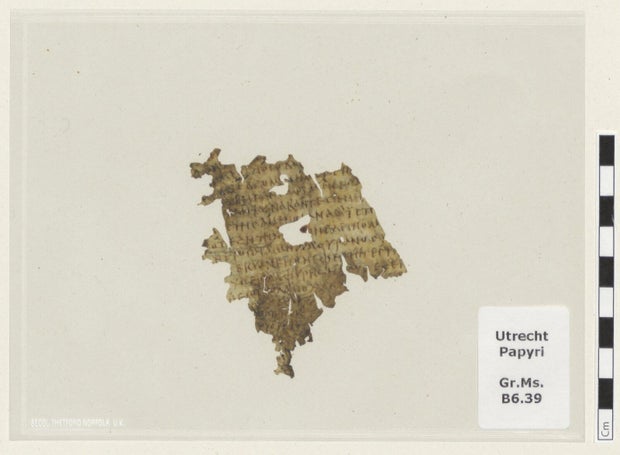
But De Kreij, a Greek teacher, recognized some of the the language on the paper and identified it as a part of Homer’s “Odyssey.”
“Everyone who learns Greek learns Homer,” De Kreij told Dutch media outlet RTV Utrecht.
Researchers were able to date the fragment back to about 300 AD, the university said, and only about 30 such fragments exist worldwide.
“I have the best job in the world,” De Kreij told RTV Utrecht. “I am a treasure hunter. Every day you find something nice. This is one of them.”
The piece of paper would have come from a pocket edition of the complete poem, the university said, owned by someone living in Egypt’s Faiyum oasis. RTV Utrecht described the fragment as about the size of a playing card. The fragment is discolored and has moisture stains, according to the outlet. Both sides have writing on them.
Utrecht University 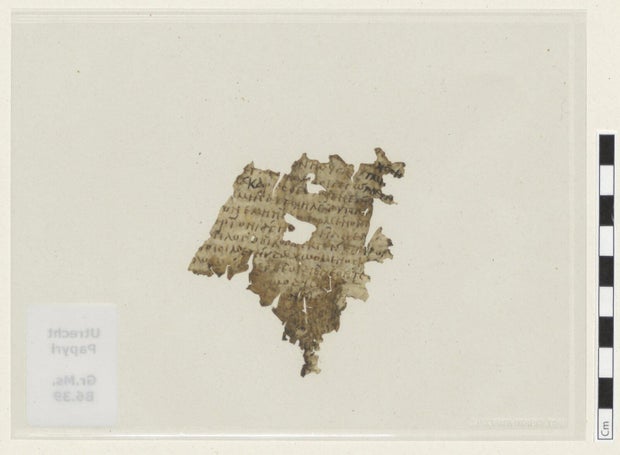
The fragment is from the 12th book of the “Odyssey,” where Odysseus tells the tale of his starving sailors devouring cattle that are sacred to the Sun God, Apollo. This moment comes about halfway through the poem. De Kreij told RTV Utrecht that because books wear from the outside in, it makes sense that the fragment would be from that portion.
“There are so many boring parts in the “Odyssey,” De Kreij said. “This happens to be a really fun passage.”