
St. Peter’s Basilica is the biggest (and for Catholics, the most sacred) church in the world. Its artworks, like Michelangelo’s Pieta, have been known to make peasants and popes weep. Everywhere you turn, you may think you’re gazing up at paintings.
But almost all of them are mosaics.
And it’s nearly impossible to tell, unless you get a closer look, inside the Cupola Clementina, 200 feet above the pews, where only restorers can go.
CBS News 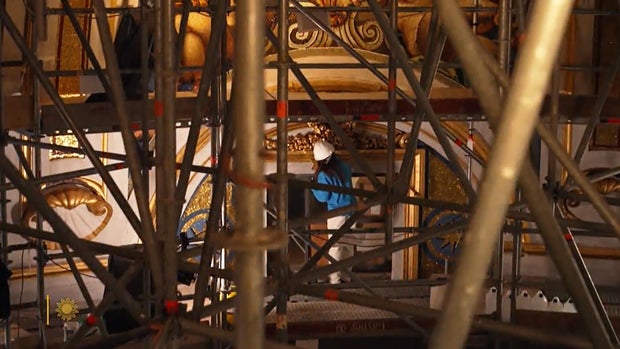
Paolo di Buono, the director of the Vatican’s mosaic workshop, showed us one mosaic, created using thousands of colored fragments. “It is very incredible that they, the mosaicists, used this kind of detail to represent, for example, this beautiful face,” di Buono said. “Using different kind of colors and melting the tiles in this way, they were able to reach many kinds of shades of colors in a very fine way.”
From a distance, the effect is like looking at an Impressionist painting – created centuries before the Impressionists.
CBS News 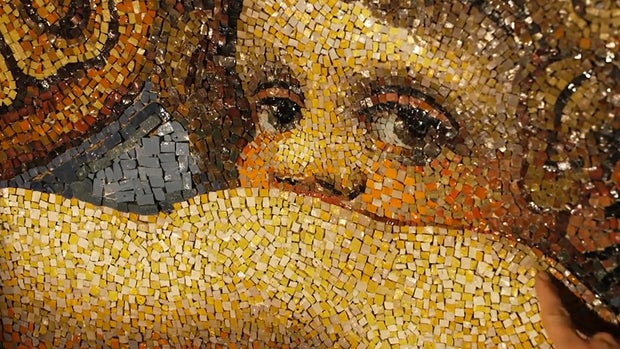
Why mosaics? Because paintings are fragile and can’t withstand the test of time. But mosaics, made of glass and gold, are more eternal.
The earliest records of the Vatican’s artworks, and the Basilica itself, are conserved inside the archive of St. Peter’s, led by Simona Turriziani. And like the mosaics, the archive seems to float in the celestial realm, inside one of the smaller domes of St. Peter’s itself. When music rises up from the organ below, it’s an experience she can only describe as divine. Not surprising, considering what’s inside.
CBS News 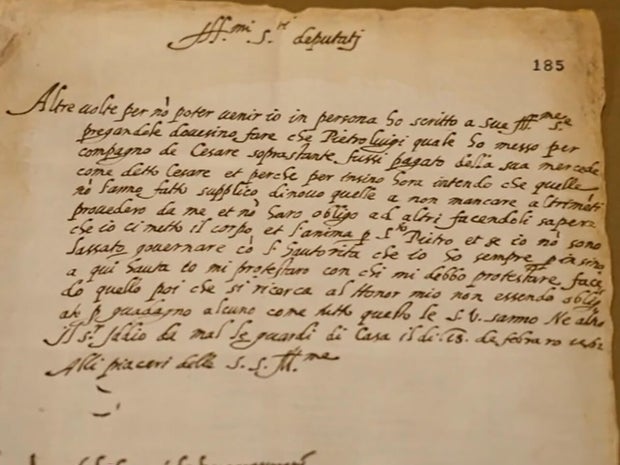
A letter dated 18 February 1562, and signed with impeccable penmanship by Michelangelo (the same hand that painted the Sistine Chapel), implores a cardinal to pay one of his workers, or else Michelangelo threatens to appeal directly to the pope. “‘I put my body and my soul for St. Peter.’ Michelangelo said this phrase, and for us it’s very, very emotional,” Turriziani said.
We then find what we came for: the earliest records of St. Peter’s mosaics, dating back to 1580, and a blueprint for a mosaic of St. Peter himself. This blueprint contained the gradient of turquoise color to be used.
Four-and-a-half centuries later, almost nothing has changed inside the Vatican’s Studio del Mosaico, the Mosaic Workshop. Both the tools and techniques date back centuries, even millennia.
The platforms they’re working on? Identical to those once used in ancient Rome 2,000 years ago. And the tool, the martellina, is a sharp hammer that allows workers to cut the pieces into the tiniest of fragments.
Perhaps no works are more important than portraits of popes, painstakingly pieced together, then installed inside St. Paul’s, outside the walls in Rome.
CBS News 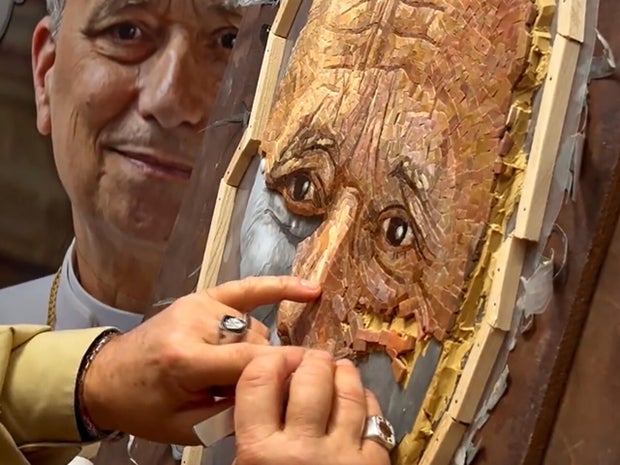
And when U.S. presidents visit the Vatican, the pope routinely gives them a gift: A mosaic landscape of the Vatican.
While painters work in oils, mosaicists work in fire. It’s a special technique di Buono calls “the filament technique, that allows us to warm, to fire the glassy colors in order to melt them and in order to create new colors.”
CBS News 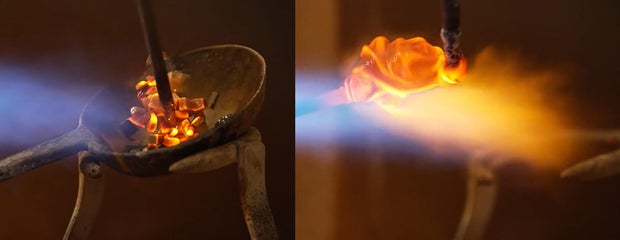
But just like the mosaics themselves, those colors are timeless, preserved inside the Vatican for generations, saved over the centuries to one day restore this sacred art to its original glory.
Asked if he is still moved by the art on display, di Buono replied, “Absolutely. It is not possible to be used to working here because you are always amazed.”
CBS News 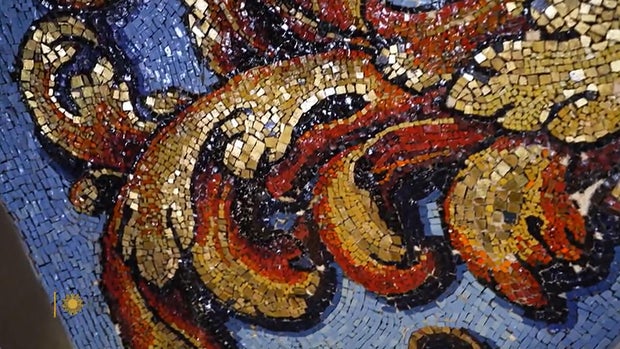
Mosaics, at least up close, are nothing more than broken fragments. But pieced together, up here, they’re nothing short of heavenly.
For more info:
Story produced by Anna Matranga. Editor: Jack Howell.