
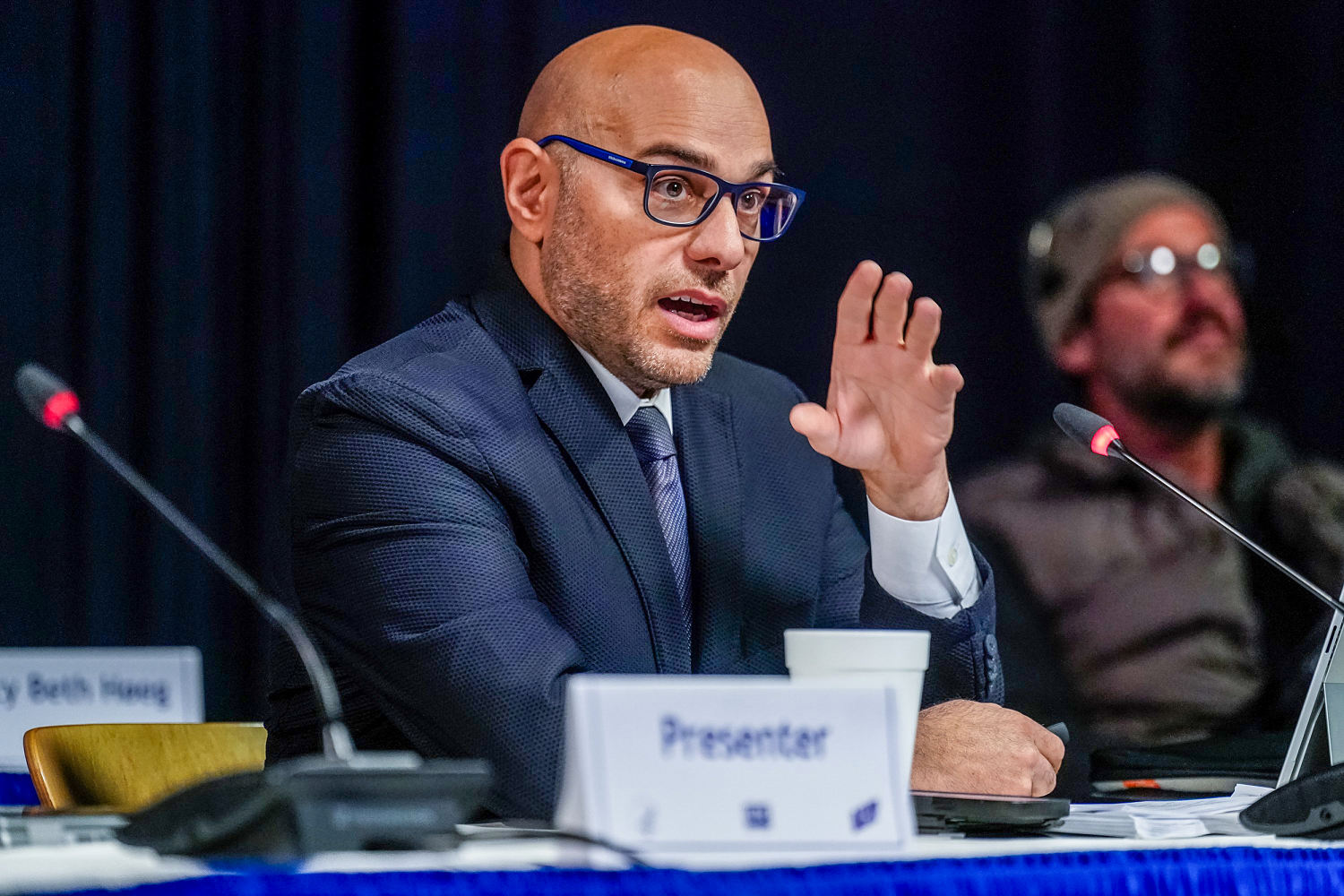
An anti-vaccine lawyer who has regularly sued federal and state health agencies spoke Friday at a meeting of the Centers for Disease Control and Prevention’s vaccine advisory panel — an unheard-of departure for the committee, which for decades was a trusted source for vaccine recommendations.
The lawyer, Aaron Siri, has also served as the personal attorney for Health Secretary Robert F. Kennedy Jr., a longtime anti-vaccine activist.
Siri delivered a lengthy presentation about the childhood immunization schedule, chronicling what he said were concerning adverse events from routine vaccines and calling particular attention to vaccines for hepatitis B, pneumococcal disease and a combination shot for diphtheria, tetanus and pertussis (whooping cough). Previously, Siri has advocated for the Food and Drug Administration to revoke its approval of the polio vaccine.
Art Caplan, head of the division of medical ethics at NYU Langone Medical Center, said Siri’s presence at the meeting suggests that the panel, known formally as the Advisory Committee on Immunization Practices, is “trying to use a pre-committed ideology to get where they want to go, which is to get rid of childhood vaccination.”
“This is a science issue, and he’s the wrong guy, with the wrong conflicts, with the wrong style, with the wrong information,” Caplan said.
Siri also pointed to a supposed link between autism and vaccines given in the first six months of life — a claim that has been widely debunked — arguing that there are no studies to disprove the link.
“If you’re going to say vaccines don’t cause autism, have the data to say it,” Siri said.
Decades of research, including extensive probes into the safety of the measles, mumps and rubella (MMR) vaccine, has found no link between vaccines and autism. A large Danish study from July found no association between aluminum exposure from vaccines during the first two years of life and increased rates of neurodevelopmental disorders. And a massive review in 2021, which evaluated 138 studies, determined that MMR vaccines don’t cause autism.
Siri suggested at the meeting that a shortcoming of several childhood vaccines is their failure to prevent transmission, pointing to research on a type of whooping cough vaccine in infant baboons. Public health experts argue that the goal of those shots is to prevent symptomatic disease and death. He further suggested that childhood vaccines weren’t properly evaluated for safety — despite decades of continuous monitoring for side effects.
“The concern is that not one of them was licensed based on an inert, a placebo-controlled clinical trial,” Siri said.
People who question the safety of vaccines often suggest that trials should be conducted with an inert placebo — meaning some trial participants would receive the new vaccine while others would receive an inactive substance like saline, to compare results.
However, public health experts say there’s a legitimate reason not to use a placebo in some cases: It would be unethical to withhold the benefit of a vaccine from study participants, so trials often test new vaccines against older versions.
“Siri’s claim that childhood vaccines were ‘never tested against placebo’ is a talking point, not a fact,” Dr. Jake Scott, an infectious diseases specialist at Stanford Medicine, said via text message. “Inert placebo-controlled trials exist for most of the routine childhood vaccines, including large studies using saline or sterile water controls published in major journals.”
Scott testified before Congress in September that his research team had documented 398 randomized control trials that evaluate the active ingredients in childhood vaccines and use inert placebos such as saline or sterile water.
Dr. Cody Meissner, a pediatrician and the only ACIP member who has previously served on the committee, said Siri’s presentation was “a terrible, terrible distortion of all the facts.”
“For you to come here and make these absolutely outrageous statements about safety, it’s a big disappointment to me and I don’t think you should have been invited, I will be completely honest,” Meissner said during the meeting.
Siri’s unorthodox presentation followed a day and a half of chaotic proceedings, in which advisory members and presenters made false claims about the safety and efficacy of hepatitis B vaccines and cherry-picked data. The committee voted Friday morning to roll back a long-standing recommendation for all newborns to get a first dose of the hepatitis B vaccine. Instead, the advisers said women who test negative for hepatitis B can consult with a health care provider about whether their baby should get the birth dose.
Kennedy fired the previous members of the advisory panel in June over what he claimed were “persistent conflicts of interest,” and replaced them with a group that has largely expressed skepticism of vaccines.
Siri disclosed a litany of conflicts at Friday’s meeting, including numerous ongoing lawsuits against the Department of Health and Human Services and its subsidiary agencies. Those include lawsuits over purported Covid vaccine injuries and exemptions to vaccine mandates, he said. Siri previously sued the CDC to compel it to turn over studies demonstrating that vaccines don’t cause autism.
Siri said he was asked to speak Friday alongside Dr. Paul Offit, director of the Vaccine Education Center at the Children’s Hospital of Philadelphia, and Dr. Peter Hotez, co-director of the Texas Children’s Hospital Center for Vaccine Development. Hotez said he declined the request because “ACIP appears to have shifted its mission away from science and evidence-based medicine.” Offit, who has similarly accused the committee of becoming political, said he could not recall receiving an invitation, but would not have attended the meeting regardless.
Caplan, the medical ethicist, said such a debate would not have been productive.
“We don’t really need to debate evolution again, probably don’t need to debate settled opinion about whether we went to the moon — and we don’t need to debate this,” he said.