
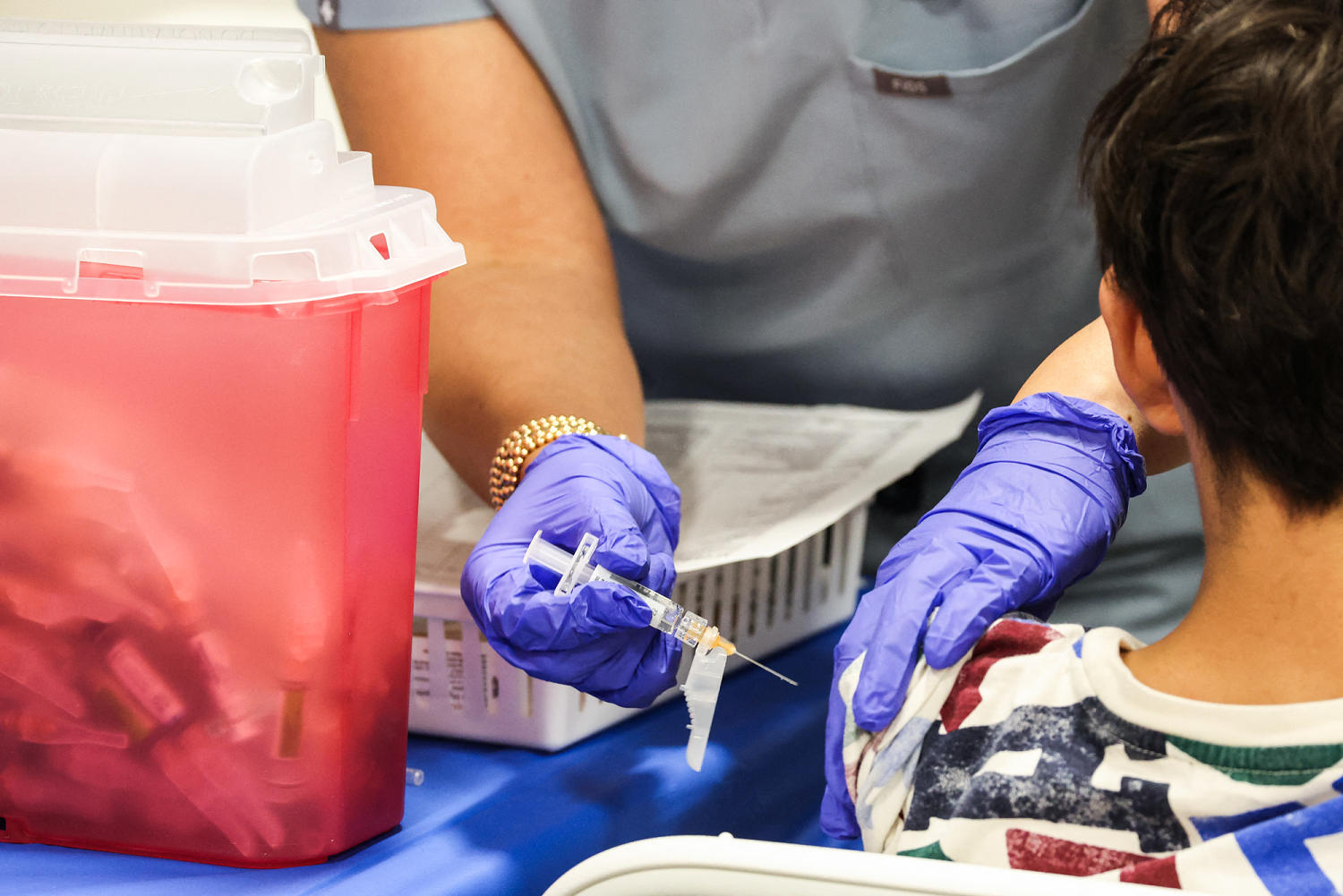
The nation’s leading group of pediatricians has issued its annual recommendations on which vaccines children should receive — marking the first significant break from the federal government’s proposed vaccine schedule in 30 years.
On Monday, the American Academy of Pediatrics said it will continue to endorse vaccines protecting kids against 18 potentially life-threatening diseases, such as Covid, the flu, hepatitis A and B and measles.
While that guidance largely reflects what’s previously been recommended, it no longer aligns with the Centers for Disease Control and Prevention. On Jan. 5, the CDC reduced the number of diseases on the vaccine schedule from 18 to 11.
“We used to partner very closely with CDC to create a unified, harmonized set of vaccine recommendations,” Dr. Sean O’Leary, chair of the AAP’s committee on infectious diseases, said during a call with reporters. “But these recent changes to the CDC schedule are a strong departure from the medical evidence and no longer offer the optimal way to prevent illness in children.”
An historic break
The AAP, which represents 67,000 pediatricians nationwide, has issued guidance on which shots kids should get every year since 1935.
In 1995, the group joined forces with the CDC and other medical groups to offer doctors and families one set of vaccine guidelines. In early January, the Trump administration’s Department of Health and Human Services overhauled the childhood vaccine schedule, citing “a need for more and better science” on vaccines.
The agency hasn’t provided specifics on what kind of science is needed.
AAP president Dr. Andrew Racine said that nothing has changed in terms of the best ways in which to prevent illness.
“This is the exact same recommendation that we’ve had along, the same recommendations the federal government used to agree with,” Racine said during the media briefing. “The distribution of these illnesses hasn’t changed, the risk of the children to the children of the United States hasn’t changed and so the vaccine schedule hasn’t changed.”
According to KFF, at least 28 state health departments have stated they will not follow the new CDC childhood vaccine recommendations. The AAP guidance has also been endorsed by major medical groups, such as the American Academy of Family Physicians, American College of Obstetricians and Gynecologists and the American Medical Association.
“There is strong alignment there,” said Dr. Kristina Bryant, a pediatric infectious disease doctor at Norton Children’s in Louisville, Kentucky. “State health departments and health coalitions have also recommended following the American Academy of Pediatric immunization schedule because it has been rigorously studied and it works to keep children and communities healthy.”
What vaccines should kids get in 2026?
Both the CDC and AAP continue to recommend a majority of childhood vaccines, including those that protect against measles, mumps and rubella, chickenpox and polio.
Here’s where the groups differ: The CDC no longer routinely recommends kids receive shots to protect against Covid, RSV, the flu, rotavirus, meningitis and hepatitis A and B. The CDC says that instead, that those shots should be given only in a “shared decision-making” scenario in which pediatricians and families talk through the pros and cons of vaccines before they’re administered.
But that’s a conversation pediatricians have been having for years for all vaccines, said Dr. Deanna Behrens, a pediatrician in suburban Chicago and member of the Illinois chapter of the American Academy of Pediatrics.
“We are well used to talking to families about vaccines. That’s something that we’ve been doing for a long time,” Behrens said. “Trusting your pediatrician is critical.”
The recent changes to the federal vaccine guidance has prompted more questions about shots in Dr. Ana Montanez’s pediatric practice at Texas Tech Physicians in Lubbock, Texas.
Families “came to me for clarity before these changes were made, and now that changes are made, it’s even more important,” Montanez said. “I definitely welcome the questions.”
Parents can find more information about the AAP’s vaccine guidance at healthychildren.org.