
London — The involvement of a small American firm linked to associates of President Trump in an energy project in Bosnia and Herzegovina worth more than $1.5 billion has raised questions about how the White House could be using its leverage in the fragile Balkan state.
U.S. lawmakers accuse the Trump administration of lifting sanctions on Bosnian Serb separatist leader Milorad Dodik in an effort to enrich and empower allies of Mr. Trump, and of undermining longstanding U.S. foreign policy interests in the region in the process.
On Sunday, Mr. Trump was hailed by Dodik after his Serb nationalist party won one of Bosnia and Herzegovina’s three presidency seats, which are split between Bosnia’s Muslim, Serb and Croat ethnic groups under the country’s complex power-sharing electoral system.
Yevgeny MESSMAN/POOL/AFP/Getty 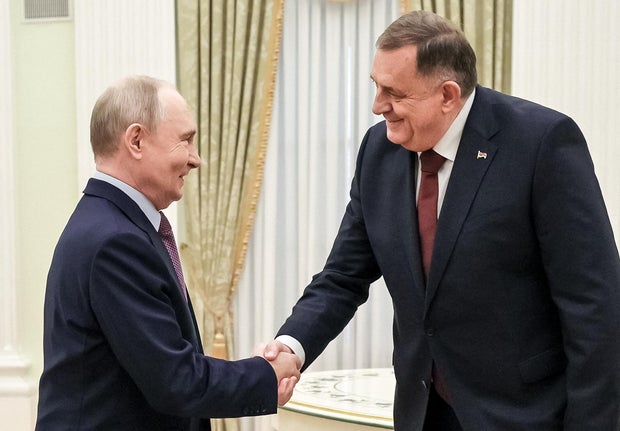
“If it had not been for Donald Trump’s magnificent victory … we would probably be political corpses today,” Dodik told supporters in a speech, in which he also thanked Russian President Vladimir Putin for his support.
Company with links to Trump poised to build gas pipeline
AAFS Infrastructure & Energy, a company incorporated in the U.S. last year and headed by President Trump’s former personal attorney Jesse Binnall and Joseph Flynn, the brother of Trump ally General Michael Flynn, is close to securing a contract to develop the Southern Interconnection Gas Pipeline.
The pipeline project has been discussed by Bosnian officials for years, but long opposed by Dodik, who has close ties with the Kremlin. But Dodik, whose party has veto power in Bosnia’s parliament, said he would not stand in the way of the proposal following the announcement of AAFS’ involvement last April. Six months earlier, the Trump administration lifted sanctions against Dodik that were imposed by the U.S. Treasury almost a decade ago.
The pipeline would connect Bosnia and Herzegovina to Croatia’s gas network, allowing Bosnia to import liquefied natural gas (LNG) from its neighbors. The project, which is valued at around $1.7 billion according to the Croatian government, would help make Bosnia and Herzegovina less reliant on Russian gas imports.
On its website, AAFS describes itself as a company focused on “energy security, project structuring, capital alignment, and long-term regional infrastructure development.”
The company does not appear to have demonstrable experience in any similar energy projects.
The secessionist leader Dodik, who until recently served as the president of Bosnia’s self-governing, Serb-run territory called Republika Srpska, has long been accused of undermining the U.S. brokered Dayton Accords, which ended the bloody sectarian violence between Bosnia, Croatia and Serbia in the 1990s.
The sanctions, which included asset freezes and visa bans, were imposed by the Obama administration in 2017. The Biden administration then imposed further sanctions in 2022, accusing Dodik of corruption, including the charge that he had handed government contracts to close business associates in Republika Srpska.
A congressional report published last month by House Democrats, titled “Pay for Play in the Balkans,” alleges that those two decisions — the removal of sanctions on Dodik and his decision to not oppose the pipeline — are directly linked.
“The Trump administration has used its diplomatic influence and connections with shady characters like Michael Flynn … to facilitate the concession contract for the SIC [Southern Interconnection Gas pipeline] to AAFS Infrastructure and Energy LLC, a company owned and operated by Michael Flynn’s brother Joseph Flynn and Trump-affiliated lawyer and political activist Jesse Binnall,” the report alleges.
AAFS Infrastructure and Energy LLC did not respond to a CBS News request for comment.
Foreign agent registration filings (FARA) cited in the report and reviewed by CBS News show that Michael Flynn, President Trump’s former national security adviser, last worked as a paid lobbyist for Republika Srpska in October 2025, the month during which the sanctions against Dodik were lifted.
Scott Olson/Getty 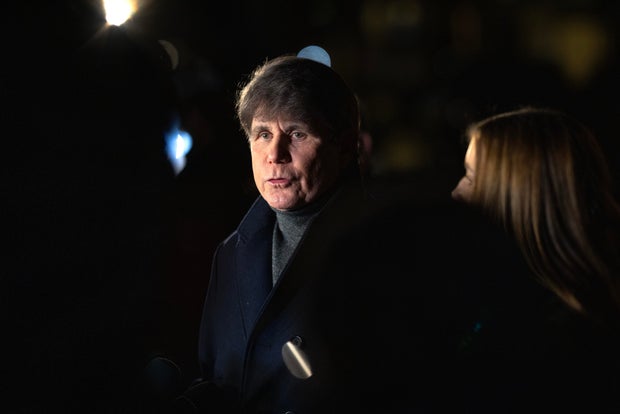
Those same filings show that Flynn was paid $100,000 for that work by RRB Strategies, a lobbying firm run by Rod Blagojevich, the former Illinois governor who was convicted in 2011 of 18 counts of corruption and spent nearly eight years in a federal prison before being pardoned by President Trump last year.
Flynn provided strategic advice and counsel, analysis and information research, and introductions to the Republika Srpska government, according to the FARA filings.
Blagoyevich’s firm originally signed a contract to “provide communications and public affairs support on behalf of the Republic of Srpska” in March 2025, separate FARA filings reviewed by CBS News show.
CBS News sought comment from email aliases associated with Flynn and Blagojevich, but did not receive any response by the time of publication.
On Nov. 13, 2025, the U.S. Embassy in Sarajevo said in a social media post that Chargé d’Affaires John Ginkel had met Bosnian Prime Minister Nermin Niksic to discuss the gas pipeline project and “to support the importation of U.S. gas through Croatia to consumers in Bosnia and Herzegovina.”
One week later, the embassy announced a preliminary agreement for an “American company to develop, build, and manage the pipeline.”
Four days after that, on Nov. 24, AAFS Infrastructure & Energy was incorporated in the state of Wyoming.
U.S. Embassy Sarajevo/X 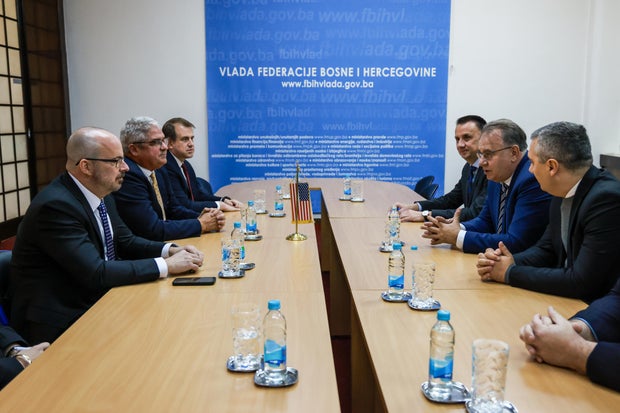
In January, the U.S Embassy in Sarajevo posted again confirming that a meeting had taken place between AAFS leadership, including Joseph Flynn and Binnall, and top Bosnian officials.
AAFS was then granted the status of lead investor and operator on the proposed natural gas pipeline in legislation passed by Bosnia’s parliament in April.
Later that month, the Croatian and Bosnian governments signed a contract to construct the pipeline with U.S. Energy Secretary Chris Wright in attendance for the signing ceremony. At a news conference with Bosnia’s energy minister on April 2, Binnall hailed the pipeline project as a “priority” for the Trump administration.
Darko Bandic/AP 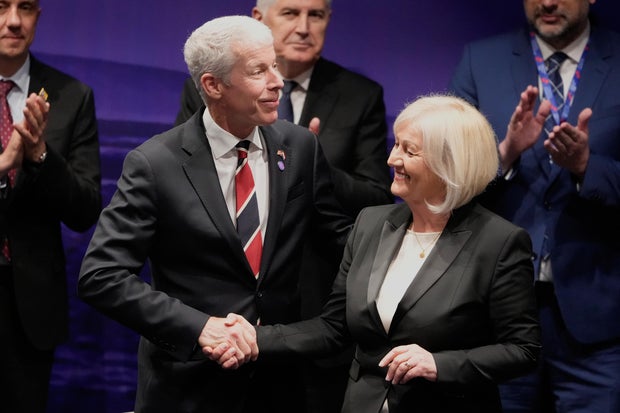
The White House declined to comment on the pipeline project last week, but an administration official said the sanctions against Dodik were lifted to prevent instability in the Balkans.
“This is yet another example of President Trump’s pragmatic, farseeing foreign policy that has prevented disasters on perennial issues that his predecessors so often stumbled into,” a White House official told CBS News on Friday, without elaborating on the type of disasters the Trump administration was preventing.
A State Department letter published as part of the House Democrat-authored congressional report said the decision to delist Dodik had helped ensure peace and stability in Bosnia and Herzegovina. The official who wrote the letter, Paul Guaglianone, said lifting sanctions against Dodik had led to Bosnian Serb separatists rolling back policies that would have destabilized Bosnia’s government.
The lifting of sanctions “advanced U.S. interests in [Bosnia and Herzegovina] and the Western Balkans. On October 18, the Republika Srpska National Assembly (RSNA) withdrew most of the anti-Dayton legislation it had passed in recent years,” the letter read. That legislation had included laws that would have blocked Bosnia’s national police and judiciary from having any authority in Republika Srpska.
Political scientist and Balkans foreign policy expert Jasmin Mujanović told CBS News the legislation in question had already been struck down prior to the lifting of the sanctions against Dodik, and he was skeptical of the Trump administration’s justifications for the move.
“This package of omnibus secessionist laws that the Serb nationalist authorities and the RS [Republika Srpska] entity in Bosnia had unlawfully voted through in the local assembly had already been struck down by the Constitutional Court of Bosnia Herzegovina,” he said.
“If the argument is that the Trump administration nevertheless managed to get Dodik and his people to withdraw the laws, it’s still unclear what the significance of that is, or for that matter, why, given that the laws are moot,” he said, adding that it that would “result in sanctions relief for an entire regime.”