
Bubbles rise through the murky green water as divers tenderly explore a rare 15th-century shipwreck off Stockholm’s coast, believed to be the oldest warship found off Sweden.
“It’s a very big ship, it was around 40-45 meters when it sailed probably,” project leader and marine archaeologist Hakan Altrock from Sweden’s Museum of Wrecks said, overseeing the dives down to the skeletal remains of what is known as Vrak 5, or Shipwreck 5, on a cool October day.
Located off Haringe Castle south of Stockholm, the vessel is thought to be the oldest warship found off Sweden or Denmark, which were joined in a union with Norway in the 15th century.
First discovered in the late 1800s, the shipwreck is one of five lying on the seabed in the Landfjarden sound, most of which have been dated to the 1600s and 1700s.
But in February 2025, researchers were able to date Vrak 5 to the 1480s, or possibly even the 1460s.
“It’s not possible to say if it is Swedish, it could also be Danish,” Altrock said, noting that the timber used to build it comes from the area that is now southeastern Sweden.
“This is the first example of a ship in the Baltic that has been built with the carvel technique… in Scandinavia that we know of,” he said.
He was referring to a boat-building technique where hull planks are laid edge-to-edge rather than overlapping, which made it possible to build bigger and sturdier vessels — necessary with the advent of heavy cannons on ships.
Vrak Museum of Wrecks 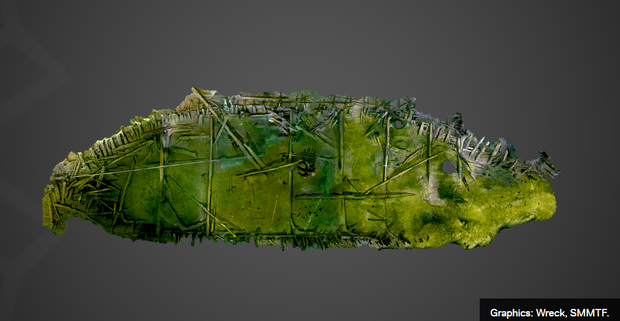
Researchers have produced a 3D scan of the wreck, which can be seen here.
“This is the most historically interesting wreck in the area,” Altrock said. “Every time we can examine part of it, we have the opportunity to find new clues.”
Sunk in battle?
Marine archaeologists excavated the wreck this week in order to better document it, find out more about how it was built, and as part of a special project about food on board.
Archaeologists aim to “search for the ship’s kitchen and gain new clues about how the ship was built and sank,” the museum said in a statement.
Among other things, they used special pumps to vacuum up sediment and expose parts of the construction.
Divers found bricks that suggested they had found the galley, in addition to parts of the ship’s rigging.
Matilda Jarl, a PhD student in marine archaeology also at the site, said the crew would have eaten fish, meat and porridge on board.
“A lot of the food would be boiled. So there would be a lot of pottage, which is basically anything that is cooked in a pot,” she said.
“With the food they would also drink beer. The people with a higher status on board would be drinking wine also, but the general crew would be drinking beer instead of water as it kept better,” she added.
It is not yet known why the ship sank where it did.
Altrock said rumors from when the wreck was found in the 19th century referred to a fire on board.
“Perhaps it was sunk when they (the Danes) attacked the Haringe Castle behind us in 1501,” he said. “That’s one theory.”
“Maybe we’ll find traces of where it burned. We’ll see.”
Other shipwrecks found in region
Several other wrecks and relics have been found in the region recently.
In April, officials announced that a 16th century shipwreck providing “unique historical and archaeological information” had been discovered off Sweden’s southeastern coast. The ship is believed to have been built in the late 1500s, which would make it older than Sweden’s iconic 17th century warship “Vasa” on display in Stockholm after being salvaged in the 1960s. The navy vessel HMS Belos found the wreck during a military exercise.
In February, a Swedish Navy shipwreck buried underwater in central Stockholm for 400 years became visible due to unusually low Baltic Sea levels.
In July 2024, a team of divers discovered a massive haul of champagne and wine on a shipwreck on the floor of the Baltic Sea off Sweden. The precious cargo was later declared off limits by the government.
That same year, researchers exploring an ancient shipwreck off the coast of Sweden discovered centuries-old artifacts, including a weapons chest and pieces of armor.