
For more than 20 years, Dr. Jennifer Litton has been treating patients with breast cancer, particularly aggressive cases in young people and pregnant people.
But her own family had been cancer-free until just a few years ago, Litton, 56, professor of breast medical oncology and chief clinical research officer at the University of Texas MD Anderson Cancer Center, tells TODAY.com.
She’d found herself in the “sandwich years,” she says, raising her three children, as well as caregiving for her parents (both of whom are now cancer patients), on top of a high-stress job.
It’s at times like that when “we as women tend to not take care of ourselves,” Litton says. She’d started stress eating and stopped exercising as much. After her parents remarked that she “looked awful” — something “only your parents can say to you,” Litton says — she took stock of the changes in her life.
Last fall, Litton decided to get all of her medical appointments taken care of, including getting her cholesterol checked, her colon cancer screening done and her mammogram.
“I’ve been called back for mammograms all the time. I’ve had maybe three or four biopsies in the past,” she says. So, when she got the call to come back this time, she didn’t think much of it.
But this time something was different. She looked at the images herself and saw “a whole big cluster of new calcifications,” she says, which are calcium deposits that form in breast tissue. While they’re often totally harmless, they can sometimes indicate a more serious issue, including breast cancer.
“As I looked on (the screen), I was like, oh, that’s going to be something,” Litton recalls.
‘That’s Going to Be Something’
Litton had to do “what we ask all our patients to do,” she says. “In the middle of their life, of working, of taking care of their kids … I was trying to fit in a diagnostic mammogram, an ultrasound. I had to fit all this into my busy life and navigate the healthcare system.”
A biopsy ultimately revealed that Litton had ductal carcinoma in situ (DCIS), a non-aggressive form of breast cancer sometimes called “Stage 0.”
She describes the outer wall of the milk duct like a sausage casing “that’s thin but strong, and it keeps everything in the shape it’s supposed to be.” In DCIS, the cells are abnormal and dividing in an uncontrolled way, but are still contained within the sausage casing.
“But you can imagine, as those cells divide, eventually they’re going to bust out and invade into the surrounding tissue,” she says, which is why it’s important to treat DCIS early.
The diagnosis wasn’t a surprise for her. An estimated one in eight women will develop breast cancer in their lifetime, she says, adding, “There’s more than eight of us who take care of breast cancer patients at MD Anderson.”
But for Litton, who typically spends her days treating patients with some of the most challenging, aggressive breast cancer cases, “I was always expecting the other shoe to drop,” she says.
“At every step I was expecting I’m going to have to do a more aggressive surgery or radiation, or I’m certain to need chemo down the road,” she says. “And actually, I didn’t.”
Surprisingly Less Invasive Treatment
Although she’d briefly considered a double mastectomy to prevent the cancer from returning, Litton opted for a lumpectomy instead. This less invasive type of surgery involves removing only the tumor and a small area of healthy breast tissue surrounding it.
Although she had to have a larger area removed than initially expected, she was able to have the plastic surgery team come at the same time. They made the area “look nicer than I think it would have if you left a 3 centimeter cavity there,” she laughs.
After she healed, she underwent radiation treatments. Going through the process firsthand gave her a new perspective on the ways it’s changed during her career. For example, she was able to have targeted radiation, which didn’t involve the whole breast or lymph nodes, and meant she didn’t need tattoos to guide the radiation like she might have in the past.
The hardest part for her was having to hold her arm up during the MRIs and radiation sessions. “I wasn’t expecting how much you have to get that arm ready and to be able to lift it up and keep it steady for a long period of time,” she says, adding that it’s now something she tells patients to be prepared for.
The ‘True Beneficiary’ of Clinical Trials
Being diagnosed with DCIS, “I know that I pulled the lucky straw out of breast cancer,” Litton says. But she also sees herself as the “true beneficiary of all the women who’ve been in all the clinical trials before,” she says.
Her cancer was caught in the earliest possible stage through routine screening, and at every decision point during her cancer journey “I had solid, emerging data that I could take a turn for a less toxic intervention,” Litton says.
For example, when deciding on surgery, radiation and a daily hormone medication, she was able to choose a less intense or invasive, tailor-made option for each than she could have even just five or 10 years ago.
Insights Into the Emotional Side of a Cancer Journey
The experience gave Litton a new window into the complex emotions that many cancer patients go through during and after treatment.
First, she encountered the challenge of telling those around her about her diagnosis. And, outside of a few “medical girlfriends” and her family, she kept the situation private.
“It wasn’t that I was trying to be secretive,” she explains. “It was just that, when I did tell a few people that weren’t in (the medical field), I had to stop and spend a lot of time consoling them and trying to explain.” It was something she just didn’t have the energy for on top of everything else, she realized, which came as a surprise.
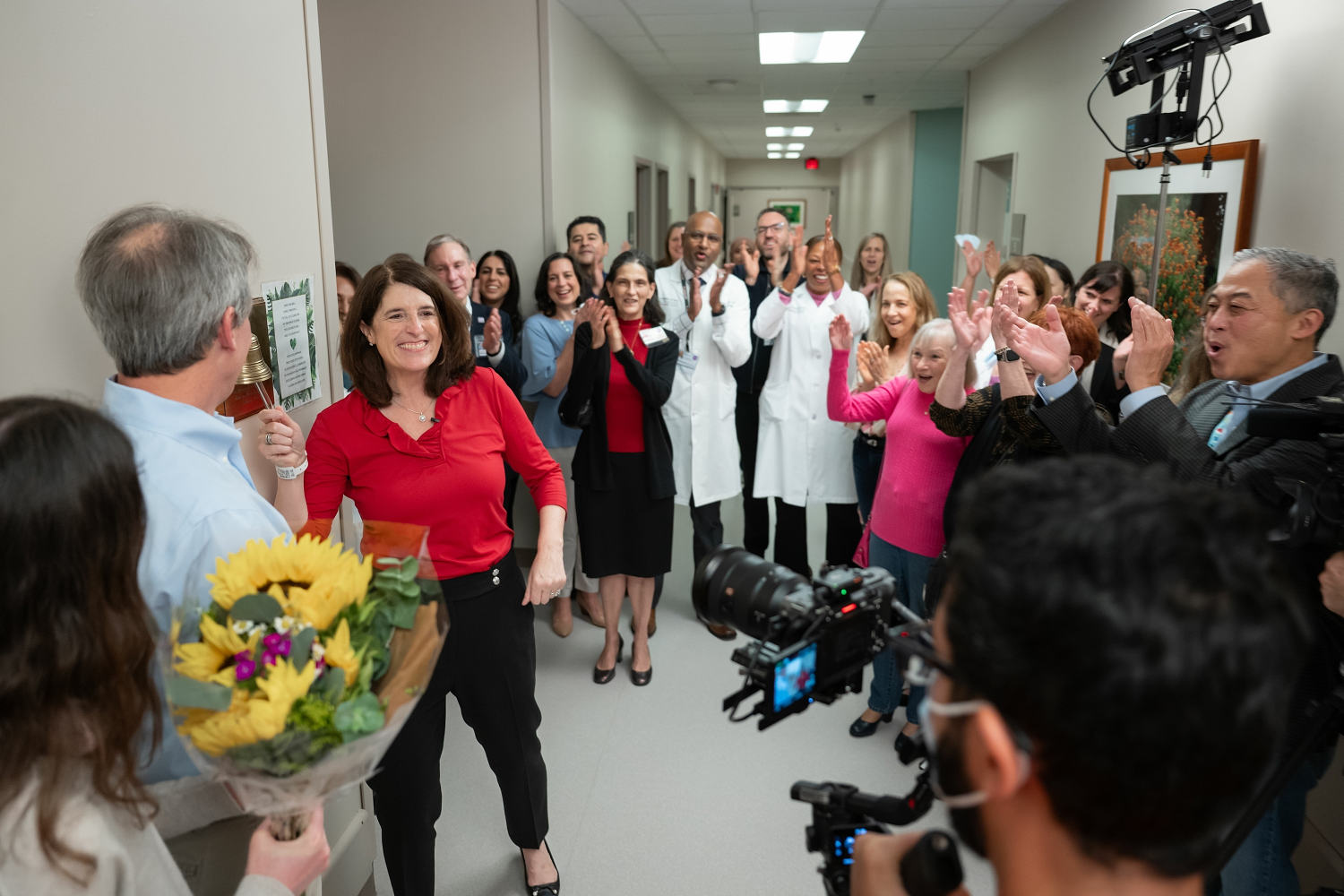
But, when she reached the end of her treatment and was getting ready to ring the bell at MD Anderson, “I said, You know, let’s just tell everyone,” she recalls, “and I didn’t really recognize how important that was.” She rang the bell surrounded by her family, colleagues and patient advocates.
And now she brings up her personal experience when it helps patients who are anxious about part of treatment, for example, or navigating the next phase of life after a whirlwind of treatments and appointments.
“You still don’t feel (normal), but you look OK, so all your friends are like, ‘Oh, she’s fine. She’s done chemo,’” Litton says. “And you have a moment to take a breath, and you’re like, what just happened to me?”
Feelings like this, which Litton likens to “a kind of PTSD,” are something the medical world doesn’t talk about or ask patients about enough, she says. The same goes for young patients suddenly thrust into early menopause due to treatment, she says or those dealing with side effects from preventive hormone medications they need to keep taking even after they’re declared cancer-free.
Rethinking What Wellness Looks Like
After her diagnosis and treatment, Litton is approaching her wellness routine in a new way.
She’s taking a medication called tamoxifen, a type of hormone therapy, which helps prevent another breast cancer from popping up. Litton has some of the usual side effects from the medication — “hot flashes, I’m a little crazier than I used to be, a little sweatier,” she says — but it’s another thing she’s able to bond with her patients over.
And her relationships with exercise and food have evolved, too.
“I got rid of the notion of, if I can’t do a full hour of exercise, I’m not really doing anything,” she says. “Anything you do is better than nothing,” she says. “If I can do five minutes, I should do five minutes.” Now, she does short bursts of activity throughout the day when she has time and keeps weights on her desk.
When it comes to food, “I have the palate of an 11-year-old boy,” Litton laughs. Alongside her DCIS diagnosis, her heart scan “was also not very happy,” she says. So she’s gone from eating foods like cheeseburgers frequently to cutting out red meat and generally trying to eat unprocessed, whole foods.
Of course, Litton will continue to get breast cancer screenings and be on the lookout for any changes in her body. “I feel like I’m doing everything I can,” she says. “I’m in a much healthier, stronger place than I was last year.”