
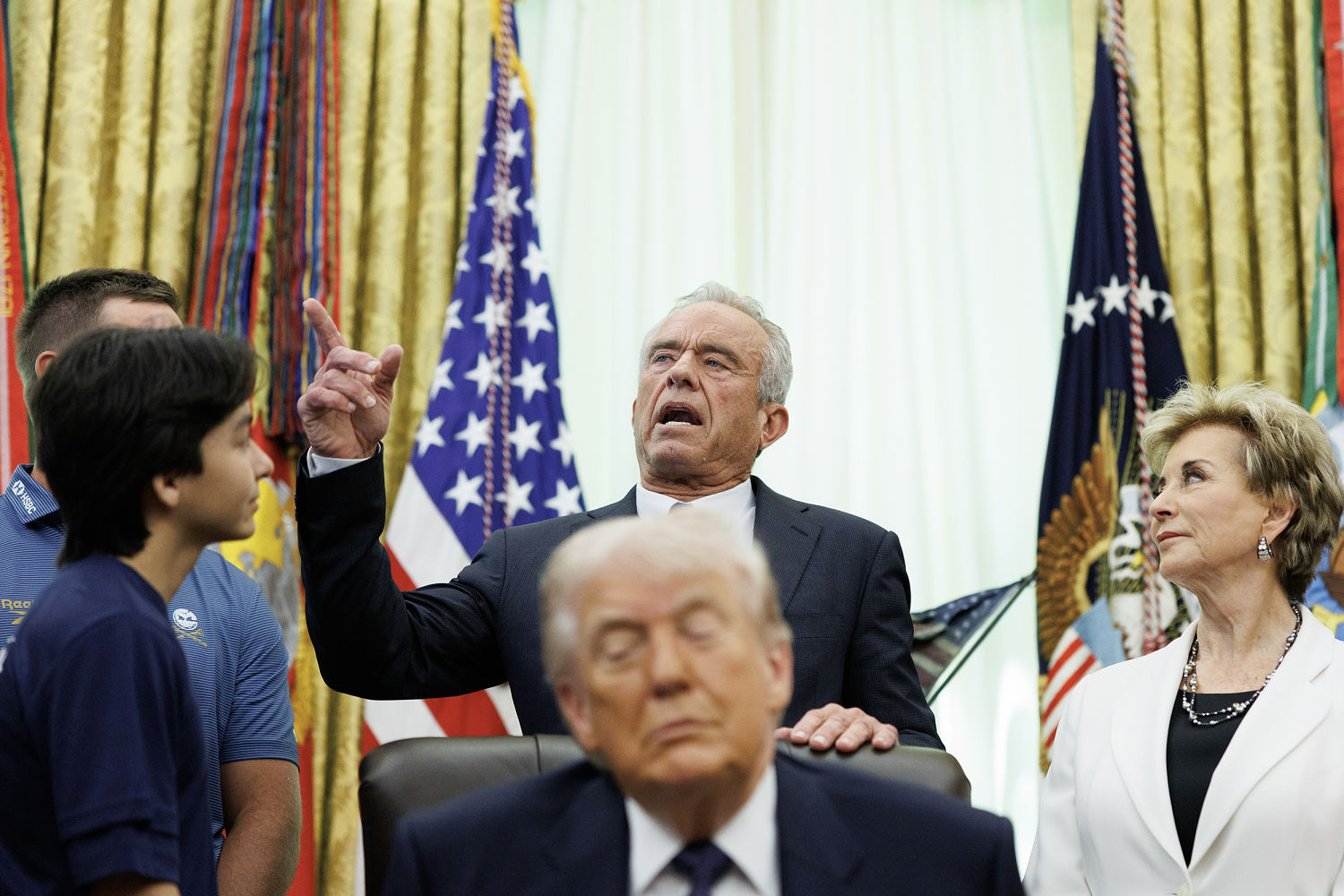
Health Secretary Robert F. Kennedy Jr. plans to announce a new nationwide competition for schools aimed at expanding participation in the Presidential Fitness Test, which President Donald Trump revived last year.
The challenge will offer $7 million in prizes to schools, districts and youth organizations that demonstrate effective ways to implement the test, the Health and Human Services Department told NBC News. Another $3 million in awards and vouchers will be available for fitness or sports equipment.
Trump signed an executive order last year to bring the test back to schools. But only 161 schools on U.S. military installations are required to do so, so the administration has looked for ways to boost participation.
Starting Thursday, organizations can apply for the cash prizes on a new federal website, Fitness.gov. Entries can be submitted until February, then winners are expected to be announced in the spring.
The fitness test is a lengthy tradition in public elementary, middle and high schools that measures children’s physical health based on their performance in various cardiovascular and strength exercises. Children compete to win awards by hitting certain benchmarks for their age and sex, such as running a mile in under 10 minutes. The exercises for the revived test under the Trump administration include a one-mile run, curl-ups, planks, pushups, pullups and shuttle runs.
The test aligns with a broader interest in fitness among several top Trump administration officials. Kennedy, who often shares his own workout videos on social media, has pledged to reverse what he describes as an “epidemic” of chronic disease in children in part by lowering obesity rates through exercise. And Defense Secretary Pete Hegseth has tightened fitness standards for military troops. The Defense Department posted a video last year of Kennedy and Hegseth challenging each other to a pushup and pullup competition.
Trump has also promised “a golden age for American sports” as the 2028 Summer Olympics approach.
A variation of the same Presidential Fitness Test was implemented in public schools from 1956 until the 2012-13 school year, when the Obama administration replaced it with the Presidential Youth Fitness Program, which focused on individual health and aimed to minimize comparisons between children.
Kennedy has criticized that change, arguing that competition is good for children.
“If we’re going to be competitive internationally, we need to be competitive with each other. We need to teach people how to win and how to lose and how to process victory and defeat,” he said at the signing of Trump’s executive order last year.
Kennedy’s uncle John F. Kennedy made a similar argument shortly after he was elected president in 1960. Kennedy has often pointed to the era of his uncle’s presidency as a time when American children were healthier, but the reality is complicated. While kids were less sedentary in the 1960s, their life expectancy is higher today, and while rates of some chronic diseases are rising among children, the trend is sometimes attributable to improvements in screening and detection. Increases in childhood obesity and Type 2 diabetes, however, are strongly associated with diets heavy in processed food and sedentary lifestyles.
Experts widely agree that young people should be more active. The federal government recommends that children ages 6 to 17 get at least an hour of moderate or vigorous physical activity each day. Only 20% to 28% of kids meet that goal, according to the Physical Activity Alliance, an advocacy group that promotes physical fitness.
However, some researchers who study physical activity among children worry that dividing kids into winners and losers the way the Presidential Fitness Test does could discourage them from engaging in fitness. The test also rewards certain types of athletic ability, they say, when there are other ways to be physically active.
Russell Pate, a professor of exercise science at the University of South Carolina, said the test is not an indicator of overall health. Many schools already use a program called FitnessGram to holistically assess a child’s physical health rather than their athletic skills, he said. Most kids will also find it difficult to meet the benchmarks for the Presidential Fitness Award, he added.
“It’s based on high-level performance in all the test items, and we know from long, hard experience that only a very small percentage of kids realistically can achieve that,” he said.