
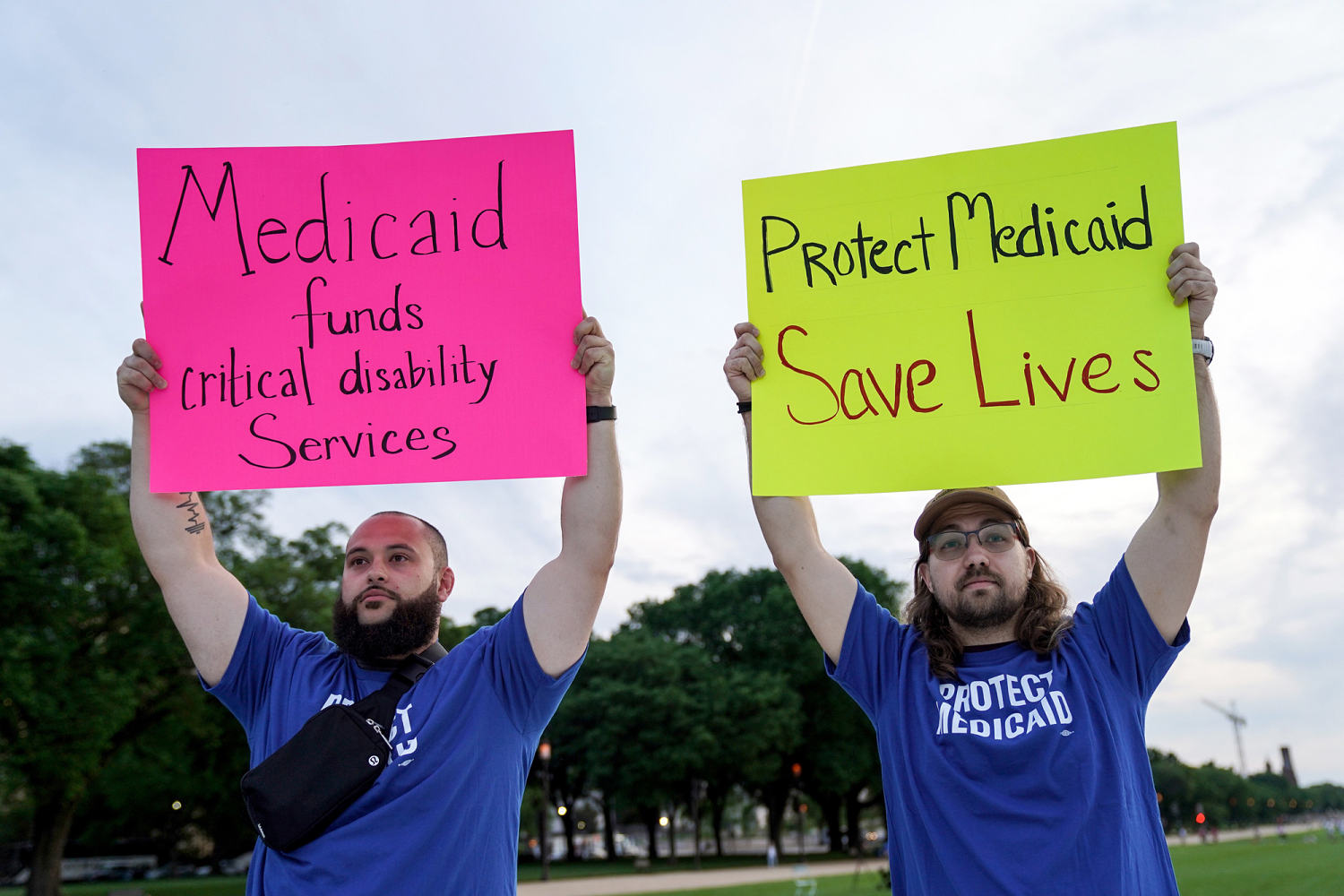
Mechanicsville, VIRGINIA — In 100 days, on Jan. 1, new federal work and reporting requirements kick in for Medicaid recipients, leaving roughly 10 million Americans at risk of losing healthcare coverage, as states scramble to prepare for the most substantial change to the program in decades.
A new, $2 million campaign called “Keep Your Care,” an independent nonprofit, launched on Wednesday. Shared exclusively with NBC News, it aims to educate states and Medicaid recipients ahead of the massive change.
For Melanie and Greg Stephens, who live in a small town outside of Richmond, Virginia, the resources can’t come soon enough. On Aug. 31, the family received a letter in the mail informing them of the new guidelines.
“When I received the letter about all the changes coming up, I had a panic attack because I was like, ‘Oh my gosh, what does this mean?’” Melanie Stephens said.
As full-time caregivers for their disabled daughter, Rachel, they are exempt from the 80-hours-per-month work or community service requirement that will affect most eligible adults in the new year. But they will still need to prove they are exempt every six months.
“Our concern is not so much on our part because we are thorough,” Greg Stephens said. “Once it leaves us and goes to a Medicaid worker to process, that’s where we are concerned they’re going to miss a deadline or fall through the cracks, and we have no control over that.”
The work requirements, supported by Republicans to address wasteful spending, were passed as part of the “big, beautiful bill” signed into law by President Donald Trump last year. But they could leave eligible recipients without coverage because of the administrative hoops they will now have to jump through, health care advocates argue.
Virginia Health Secretary Marvin Figueroa, in an interview with NBC News, described it as “fighting government for something that you’re entitled to.”
“I go back to just look at the debate that allowed this bill to pass. This is a predictable surprise,” he added. “The discussion was about losing coverage, and I think we’re going to see that across the board.”
Senate Majority Leader John Thune and many Republicans defended the cuts at the time, arguing they were “targeting waste, fraud, and abuse in the program” and also “want to make sure that this doesn’t hurt beneficiaries.”
“And what’s being said out there by the Democrats is totally inaccurate,” Thune said in an interview last year, days before his chamber voted to pass the legislation. “It doesn’t cut Medicaid … What we’re talking about here is getting rid of waste, fraud, and abuse, strengthening and improving the program for the people who need it the most and for whom it was intended, and really making this program more solvent for the long term.”
Keep Your Care was established by two health care advocacy groups, Caring Across Generations and the Healthcare Education Project, and the Service Employees International Union. The group’s state-level work will focus on Georgia, North Carolina, Illinois, Michigan, California, Virginia and New York, states with Medicaid expansion under the Affordable Care Act where millions stand to lose coverage. The group is working with communities to help eligible Americans maintain coverage, and influence state and local governments on how the new requirements are implemented. Its website will list state-specific information about what is changing, determine the requirements and exemptions that may apply and track reporting deadlines.
Greg Stephens admitted that, as a physician, he judged patients who were covered by Medicaid until he became a recipient himself. But his daughter Rachel, 22, has faced increasing health challenges since COVID and requires 24/7 management: so much so that he quit his job last year, just as his wife had years before. With no income on paper, they had to apply for Medicaid.
“We spent months calling other insurance companies and other agents and trying to find another way, and there was no other way,” Melanie Stephens shared during an interview at the Stephens’ family home, accomplished because Rachel’s grandparents looked after her during the 30-minute window.
The coverage allows the Stephens to care for Rachel, who is bound to a wheelchair, at home, which also means administering medications five times per day and feeding her through a tube. Rachel’s care is so complex that the only other option for their daughter, the Stephens said, would be an institution.
“There’s no one that could possibly care for her medically, or emotionally or cognitively,” the Stephens shared, adding: “She would have no will to live.”
The Stephens acknowledged that while there may be some individuals on Medicaid who could work, the changes made were an overcorrection, burdening eligible families with unnecessary stress and paperwork.
“There’s a lot of people that are getting health care through Medicaid expansion, like ourselves, that absolutely need this exclusion to be able to do what we do,” Greg Stephen said.