
President Trump said Saturday he would love to see a unified Ireland as he kicked off a visit to the country, where he will meet with leaders and attend a major golf tournament at one of his courses.
During a meeting with Irish Prime Minister Micheál Martin in Dublin, Mr. Trump said the unification of the Republic of Ireland with Northern Ireland, which is part of the United Kingdom, “may as well happen now.”
“I don’t want to cause any problems but I’d love to see it unified. I think it would be a fantastic thing,” Mr. Trump said, adding that “the U.K. will have something to say about it, obviously.”
Later on Sunday, while addressing business leaders from both countries gathered at the U.S. ambassador’s residence, Mr. Trump acknowledged there is “no good answer” to the reunification question.
Charles McQuillan / Getty Images 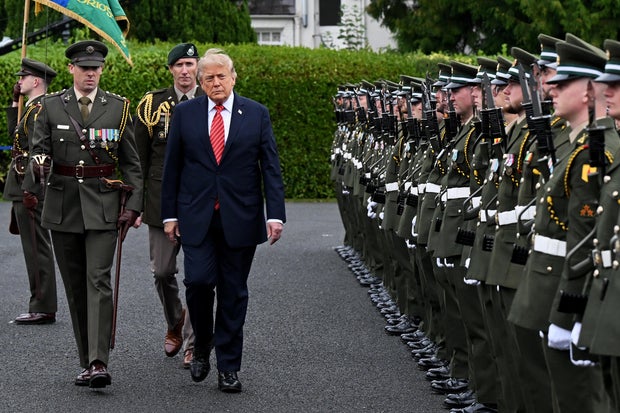
When Ireland became a self-governing Roman Catholic-majority country a century ago, a six-county region in the north with a Protestant majority remained part of the United Kingdom. Tensions between Protestant unionists, who wanted to stay British, and Catholic nationalists, who wanted to join the rest of Ireland, led to three decades of violence.
A 1998 peace accord that the U.S. was instrumental in striking largely ended the violence but left Northern Ireland’s ultimate status unresolved. That agreement allows for a vote on unification if it appears likely a majority of people would vote for it.
U.K. Prime Minister Andy Burnham insisted last month that a unity referendum was “off the table.” He said Wednesday that the U.K. would only consider allowing a referendum “when public opinion has changed to the point where the call has to be considered.” Burnham’s office referred back to that comment when asked about Mr. Trump’s remarks.
Previous American presidents, including Democrat Joe Biden, who has strong emotional ties to Ireland, have avoided commenting directly on the subject.
“As unionists we are not interested in the destruction of our country by joining with the Irish Republic,” Gavin Robinson, leader of the pro-British Democratic Unionist Party, said on X in response to Mr. Trump’s comments.
Mr. Trump also held talks Saturday in Dublin with his Irish counterpart, Catherine Connolly, a left-wing politician who joined protesters when the president visited Ireland in 2019 during his first term in office. She is now Ireland’s elected, largely ceremonial head of state. A supporter of the Palestinian cause, Connolly has in the past criticized U.S. policy in the Middle East and called Mr. Trump a “bully.”
Charles McQuillan / Getty Images 
Connolly said in a statement after the meeting that she conveyed to Mr. Trump “the strong view of the Irish people that the normalization of war and genocide can never be accepted.” She gave Mr. Trump several gifts, among them a collection by the late Irish poet Michael Longley that includes the sonnet “Ceasefire.”
Asked about the meeting, Mr. Trump first had his protocol chief, Monica Crowley, answer before he was pressed and said it was “very nice.” “We discussed a lot of things, quickly,” Mr. Trump said.
After his meetings in Dublin, Mr. Trump traveled to his oceanfront golf club in Doonbeg, on the other side of the country, to watch the Irish Open.
Separately, a collection of left-leaning opposition parties, anti-military groups, pro-Palestinian organizations, environmentalists and others plan to demonstrate against the president in Dublin on Saturday.
Mr. Trump is an avid golfer who frequently plays at clubs he owns in Florida, New Jersey and Virginia. His attendance at the Irish Open continues his trend of appearing at high-profile sporting events – and having a hand in organizing some of them in ways that benefit his family business. His clubs in Doral, Florida, and Bedminster, New Jersey, have each hosted professional golf tournaments this year.
The Irish Open is the second European Tour event to be held at a Trump property this year. The Nexo Championship was held last month at the president’s golf course in Aberdeen, Scotland.