
U.K. Defense Secretary John Healey resigned on Thursday, citing a shortfall in planned funding for Britain’s armed forces at a time of mounting international security challenges.
In his resignation letter to Prime Minister Keir Starmer, Healey wrote that the Labour government entered office “recognizing Britain faced a new era of threat which demanded a new era for defense,” but that the government had failed to deliver the resources needed to meet those challenges.
He said the government’s plan for defense, which he was “first given in full” on Monday, “falls well short of what is required for defence and the country at this dangerous time.”
Healey’s surprise departure follows months of disputes over the government’s Defense Investment Plan, or DIP. Healey said the plan had been the subject of extensive discussions recognizing the “scale of the challenge” posed by both national and international security threats.
In February last year, Starmer suggested that the government’s ambition was to raise defense spending to 3% of GDP within a couple of years. Months later, NATO leaders agreed on a target of spending 3.5% of GDP on defense by 2035. Starmer is set to meet with NATO counterparts in Ankara in July to discuss defense commitments.
Wiktor Szymanowicz/Future Publishing via Getty Images 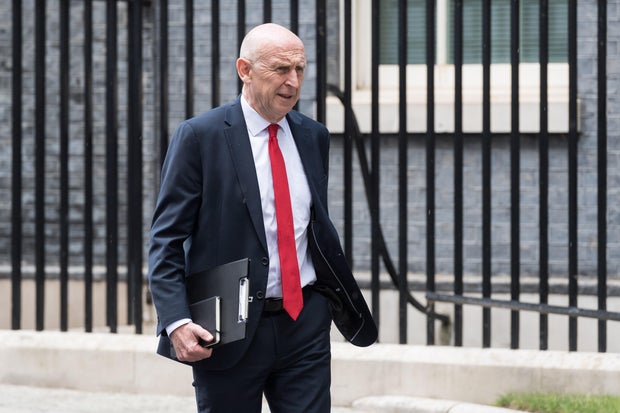
“You know what defence needs,” Healy wrote in his letter, addressing Starmer. “You made the argument for this powerfully in your speech at the Munich Security Conference back in February. Without a DIP that meets the moment in this way, I am being forced to make decisions that would reduce the readiness of our Forces and increase the risk to personnel on operations, and could make the country less safe.”
“After explaining to you that I would not be able to accept a DIP settlement that does not give our Forces the resources they need, I am now left with no other option than to submit my resignation as your Defence Secretary,” he added.
Healey’s criticism comes as Britain takes on an increasingly prominent role within NATO and other Western security missions. In his letter, he pointed to a range of commitments stretching military resources, including conflict in the Middle East, where the U.K. is co-leading a multinational Strait of Hormuz mission, and growing security concerns in the Arctic, where Britain now leads NATO’s Arctic Sentry operation.
He also highlighted increased Russian activity directed at the U.K. and its allies, as well as Moscow’s escalating attacks on Ukraine. Those concerns have intensified following the Paris Agreement on Ukraine, which sees a British military deployment after any future ceasefire.
His departure is the latest challenge for Starmer’s government and comes at a particularly difficult time for the prime minister. Opposition parties reacted swiftly to the resignation, largely echoing Healey’s criticism of the government’s defense policy.
“This is a government in chaos, unable to govern, with no leadership, under a caretaker Prime Minister who’s expected to be replaced within weeks,” said Green Party leader Zack Polanski.
Opposition leader Kemi Badenoch said she was “glad” that the former Defence Secretary “agrees” with her assessment of the government’s approach, calling it “shocking” that, according to Healey’s letter, the current spending plan could leave British troops at risk.
Since returning to office, President Trump has repeatedly criticised NATO members for failing to contribute enough to the alliance’s collective defense and has renewed threats to withdraw from the alliance.
Britain has publicly committed itself to strengthening NATO’s deterrence posture and expanding its role in European security. Healey’s departure suggests that delivering on those promises may prove more politically and financially difficult than anticipated.