
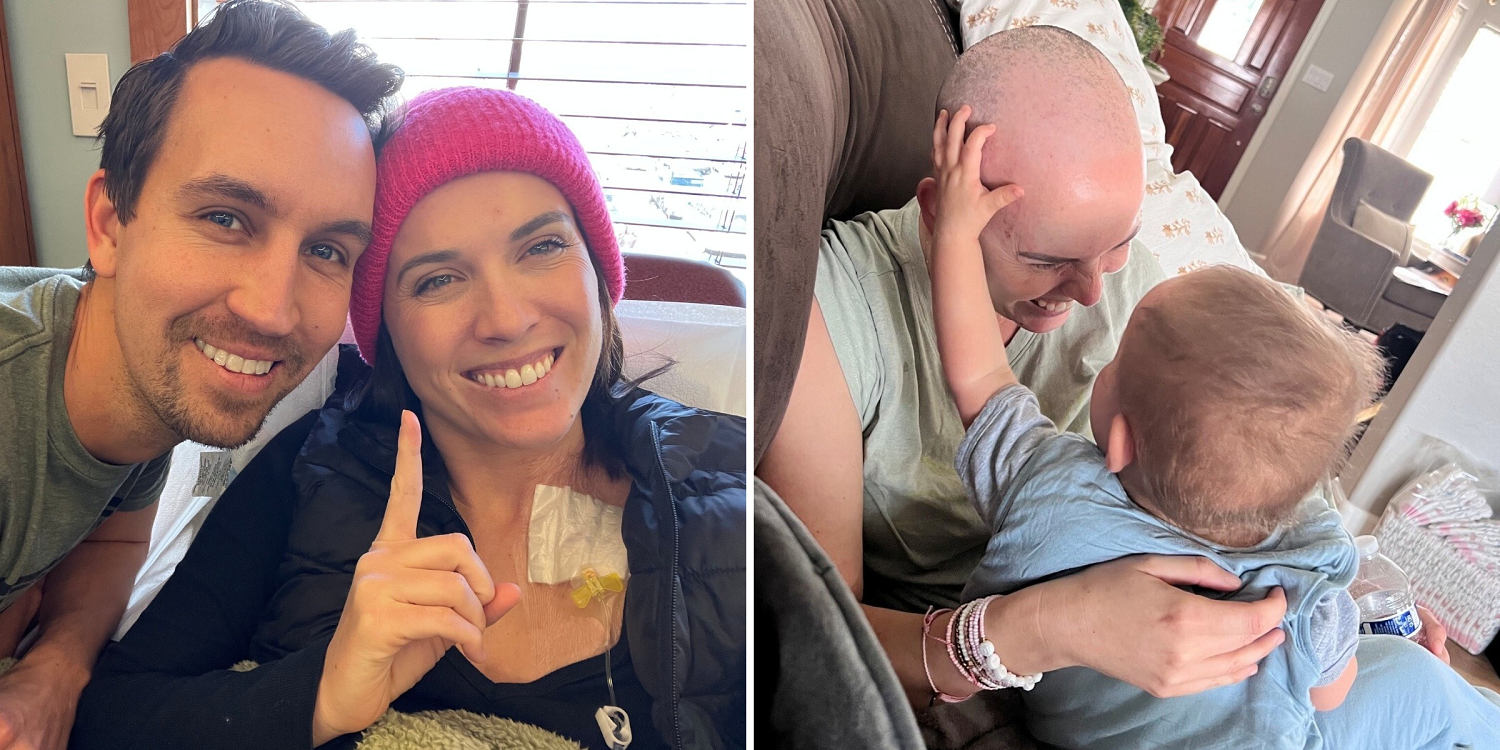
In October of 2023, Marci Bothwell had just turned 33 and completed her certification to become an oncology nurse.
The mom of three was very knowledgable about the symptoms of many cancers, and how to monitor for them. But she wasn’t looking for unusual changes in her breasts when she found one.
“It’s kind of a funny story,” Bothwell, who lives with her husband and children in southern Utah, tells TODAY.com.
“I was watching an Instagram reel about how your nipple is your perfect lip color. So I went to go check what my perfect lip color was, and I noticed a small dimple on the side of my nipple,” Bothwell says.
When she pressed down on her left breast, something felt off.
“It was like an area of hardness in my left breast. There wasn’t a clear edge and it wasn’t really movable, but it was quite large,” she explains.
Bothwell was surprised she hadn’t noticed it earlier, given she had only recently stopped nursing her 18-month-old.
“I hadn’t been done breastfeeding for that long, and I felt like I had been pretty aware of my breasts. So whatever it was had grown pretty quickly for it to be that large already,” she says.
Bothwell saw her primary care doctor, who ordered an ultrasound and a mammogram.
Inconclusive Imaging
“We started with the ultrasound, and they said they couldn’t really see much. So I got a mammogram, and I remember the radiologist told the tech, ‘I don’t really see anything, she’s good to go’” she says.
Bothwell was told that the scans were inconclusive, but nothing concerning was visible on the imaging and that she could return for routine screening at age 40.
“I remember feeling like I was crazy because there was a large lump there. … I left that appointment feeling really confused and not at all at peace with the situation,” says Bothwell.
Based on the radiology report, her doctor suggested she could have fibrocystic breasts. It’s a common, benign condition that causes dense, lumpy breast tissue and cysts that can fluctuate in size around menstruation, per the Cleveland Clinic.
“I thought, I don’t have any family history of cancer, and I am only 33, so surely it’s not cancer. I was happy to move forward believing it was fibrocystic breasts,” she says.
Two months later, in late December of 2023, Bothwell noticed a new change. “I started to have more dimpling in the area that was harder, then my nipple inverted,” she says.
Bothwell went back to her doctor and pushed for more scans and testing. “I was like, I don’t feel good about waiting.”
Her doctor agreed and ordered a breast MRI. But the nearest hospital with a machine was four hours away, and appointments were scarce over the holidays.
“It was around Christmas, and I remember spending a lot of that break feeling something bad was going to happen,” she says.
While waiting to get scheduled for an MRI, Bothwell noticed a new lump in her armpit. “It started so small, it felt like a grain of rice. But within a few days, it was the size of a marble.”
After many calls, Bothwell was able to get an earlier MRI. She was on the way home from the hospital when she got a call from the radiologist.
“The breast MRI revealed that I had an 8 centimeter tumor in my breast, as well as lymph nodes that were suspicious for cancer in my armpit, next to my sternum and under my collarbone,” she says.
Bothwell was told to turn around and come back to the hospital for biopsies. “It was terrifying.”
Pleomorphic Invasive Lobular Carcinoma
The biopsy results came back several days later.
“It was pleomorphic invasive lobular carcinoma, grade 3C, and I had a high Ki-67 score, which means that it was a really fast-growing, aggressive cancer, (and) had spread to my lymph nodes,” she says.
Invasive lobular carcinoma (ILC) is one of the most common types of breast cancer. It affects the milk glands or lobules in the breasts and surrounding tissue, per the Mayo Clinic
Pleomorphic invasive lobular carcinoma is a very rare variant of lobular carcinoma. It makes up less than 1% of all breast cancers, and is associated with worse outcomes compared to ILC.
“I had an 18-month-old at the time and felt like he wasn’t going to know me or remember who I am because it’s stage 3C,” says Bothwell.
Her oncologist decided to start with chemotherapy right away.
“Those days from when you find out that it’s cancer to when you actually start treatment are some of the hardest. … You feel so powerless.” says Bothwell.
The oncology nurse was now a patient.
First, Bothwell had five months of AC chemotherapy.
“My husband’s actually the pharmacist who helped bring the chemotherapy program to our local hospital, so he mixed my chemo,” she says.
She expected nausea and hair loss, but some side effects caught her off guard. “I felt like I had never been so sick in my life,” says Bothwell, adding that she had extreme bone pain.
After chemotherapy, Bothwell underwent a double mastectomy and an axillary dissection to remove all of the lymph nodes from her left armpit. “They still had micro-metastases of cancer. So after my mastectomy, I did five weeks of radiation,” she says.
She credits her oncologist for treating her cancer as aggressively as it had spread and remaining optimistic.
“When I started the journey, my oncologist said it’s going to be a year of hell and then it’s going to get better.”
Journey to Cancer-Free
One year after noticing her first cancer symptom, Bothwell had beaten the odds. “I feel like I considered myself cancer-free after radiation,” she says.
In addition to getting routine exams and PET scans to monitor for cancer recurrence, Bothwell started using Signatera, a personalized blood test which looks for fragments of tumor DNA in the blood. She tested every three months.
“I got my first negative test result in October 2024, they didn’t detect any microscopic cancer so that was a huge day,” says Bothwell.
She remained cancer-free, getting negative results for another 18 months. “It’s better than winning the lottery, it’s the best feeling,” she says.
However, in February 2026, Bothwell got a low positive blood result. “That was hard and definitely unexpected.” Her oncologist ordered a PET scan, which was clear — a relief.
“We switched from testing every three months to every six weeks. Since then, I’ve done a bit of ping pong from positive to negative. But the past two have been negative, so that’s amazing,” says Bothwell. She gets PET scans every six months.
The 36-year-old feels like being proactive about monitoring for recurrence gives her more confidence. “We’re doing everything we can to catch it early so I have the best possible outcome.”
Invasive Lobular Carcinoma is Hard to Detect
After her inconclusive mammogram, Bothwell had to wait three months get a breast cancer diagnosis — only after she pushed for more scans. During those weeks, the cancer was growing rapidly.
“I’ve had to work through a lot of feelings, of being a bit mad,” she says.
However, Bothwell now knows that her type of breast cancer isn’t easy to diagnose in the early stages.
Invasive lobular carcinoma can be very difficult to detect on traditional scans because of the way it presents in the breast tissue, according to Memorial Sloan Kettering.
It grows in threadlike patterns instead of distinct lumps, so tumors are often diagnosed when they are much larger and later-stage, per the Lobular Breast Cancer Alliance.
“I didn’t know that there was this type of breast cancer that doesn’t always show up on mammograms or ultrasounds. So I trusted that I was good,” she says.
Given her background, Bothwell felt she was better able to monitor her symptoms and advocate for herself. But she worries other women may go undiagnosed for much longer. “I feel like this is something that people should be more aware of,” adds.
According to the Mayo Clinic, symptoms of ILC include:
- Hardening or thickening of breast tissue
- Flat or inverted nipples
- Dimpling
- Peeling skin
- Changes in the color, shape or size of breasts
The 36-year-old is now healthy and can be present with her children, which is what she missed most.
“I’m super involved with my kids and their sports. We love to spend time outdoors camping and hiking. … It’s those little moments with my family.”
Bothwell now has an even stronger passion for cancer care. In addition to nursing, she works as a clinical instructor for nursing students at a nearby university.
“I feel like in some ways it’s changed me for the better. I have so much more gratitude. … You feel like you’re getting more time, and I think that’s the best gift in life,” Bothwell says.